Mesh vs. Cushioned Office Chair Seats: Which Should You Choose?
Compare mesh and cushioned office chair seats, from airflow and seat feel to fit and care. Find the right seat for your home workspace.
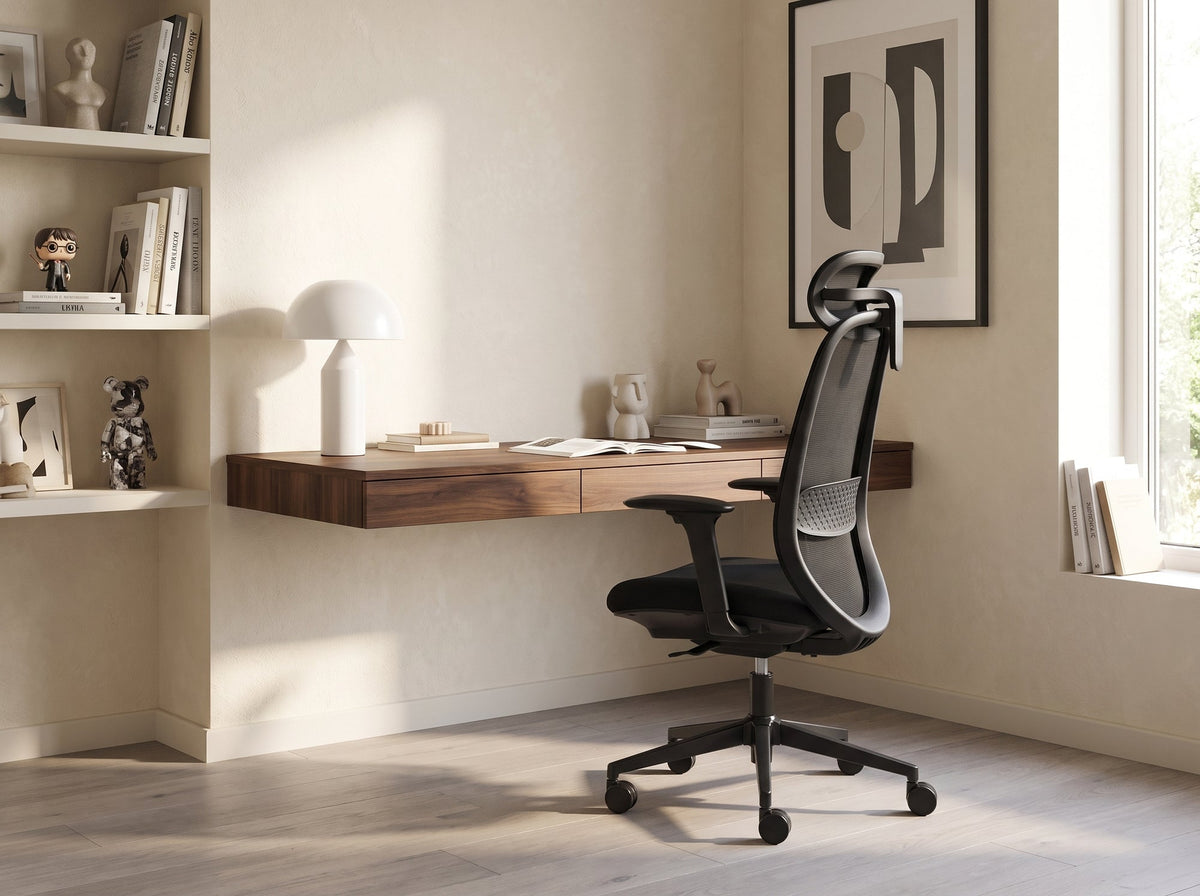
When choosing an office chair, the seat material is something you will notice every time you sit down. Some people prefer the flexible feel of suspended mesh. Others want the cushioning of an upholstered foam seat.
Both are worth considering. Your choice should reflect how you like a seat to feel, the conditions in your workspace, and how well the chair fits your body and desk.
There is also a combination worth looking at: a mesh backrest paired with a cushioned seat. It gives the back and seat different materials, each with a different feel.
Start by checking which part of the chair is mesh.
A chair described as a “mesh office chair” may have mesh only on its backrest. The seat underneath you could still be upholstered foam.
Before comparing two chairs, look at the seat and back separately:
- A mesh seat typically supports you on a tensioned material stretched across a frame.
- A cushioned seat uses padding beneath an upholstery cover.
- A mesh-back chair with a cushioned seat combines the two constructions.
These labels describe the materials. The frame, cushion shape, dimensions, and adjustments still influence how the complete chair feels.
| What to compare | Mesh seat | Cushioned seat |
|---|---|---|
| Seating surface | Suspended material supported by a frame | Upholstery over padding and a supporting base |
| Feel to check | Tension, flexibility, and contact with the seat edges | Firmness, cushion compression, and seat shape |
| Airflow | Look at how open the seating material is | Check the upholstery and cushion construction |
| During a trial | Notice whether the frame or front edge presses against your legs | Notice whether the padding feels supportive in your usual working position |
Airflow is one reason to consider mesh.
Open suspension materials can allow air to pass through the seating surface. The effect depends on the specific construction: for example, Herman Miller documents airflow through the suspension material used in its Aeron seat and back. That is a property of that design, rather than a measured cooling result for every mesh chair. Herman Miller material information
For your own workspace, consider when and where you tend to feel warm. If your back is the main concern and you enjoy a padded seat, a mesh-back chair with a cushion may suit your preferences. If airflow through the seat itself is a priority, include suspended mesh seats in your comparison.
Comfort depends on more than softness.
Cushioned seats can feel firm, soft, or somewhere in between. Mesh seats also vary in how much they flex and how their frames support the material.
If you can try a chair, sit as you normally would while typing, reading, and reaching for things on your desk. Notice the contact under your thighs and around the seat edges. Check whether you can settle back comfortably and change position without feeling restricted.
When shopping online, look for clear dimensions, adjustment information, and return conditions. A material description alone cannot tell you how a chair will fit.
Check the fit before deciding on the material.
The Canadian Centre for Occupational Health and Safety emphasizes that chair suitability depends on the user’s body dimensions, workstation, and tasks. Its guidance includes checking seat height, depth, width, and armrest positioning. CCOHS chair-selection guidance
Use these checks when comparing your shortlist:
- Seat height: Can you work at your desk with your feet supported on the floor or a suitable footrest?
- Seat depth: Can you sit against the backrest without the front edge pressing behind your knees?
- Seat width: Is there enough room to sit and change position comfortably?
- Armrest clearance: Can you move close enough to the desk and keyboard?
Apply the same checks to both mesh and cushioned chairs.
Include care and ownership in your comparison.
Read the cleaning instructions for the exact upholstery or mesh used on each chair. Check which cleaning products are permitted and whether the manufacturer provides guidance for spills.
For longer-term ownership, look at warranty coverage, available replacement parts, and support. The words “mesh” and “foam” alone do not establish how long a seat will last.
Where OTTUNI Arix fits.
Arix pairs a breathable mesh backrest with a foam seat that offers cushioning and support. It is an option to consider if you prefer padding beneath you alongside an open mesh back.
Its listed seat dimensions are 19.9 inches wide by 17.3 inches deep, with a seat-height range of 18.1–21.1 inches. Compare those measurements with your current chair and desk before choosing. You can also review its lumbar, headrest, armrest, and recline adjustments on the OTTUNI Arix product page.
If you are comparing options within a budget, our Arix buying guide for shoppers considering an ergonomic chair under $200 covers the product in more detail.
